Howth Bog of Frogs Loop: The Complete "Purple Route" Guide
Trail Facts & Stats
Route Name: Bog of Frogs Loop (Purple Arrows).
Distance: 12 km (Loop).
Time: 3 – 3.5 hours.
Difficulty: Strenuous (Rough terrain and cliff edges).
Elevation Gain: 240m (Includes Shielmartin Hill).
Start Point: Howth DART Station (exit left onto the quay).
Gear: Hiking boots essential (muddy sections near the golf course).
What is the Bog of Frogs Loop?
The Bog of Frogs (Purple Route) is the longest and most diverse of the four official loops on Howth Head. While most tourists stick to the shorter Green or Blue cliff paths, the Purple route takes you further—wrapping around the sea-facing edge of the headland before rising up Shielmartin Hill for the best panoramic views in Dublin.
Few places change as quickly as Howth. Every turn brings a new boundary, from land to sea, forest to hill, noise to quiet. Walking it feels like moving through a dozen worlds in a single loop.
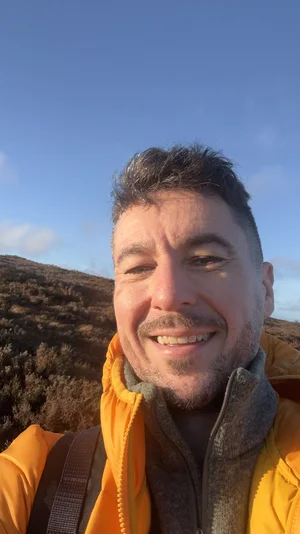
Today I’m hiking the Bog of Frogs Loop, a twelve-kilometre circuit that wraps around the sea-facing edge of the headland before rising up Shielmartin Hill. The Purple Arrows guide the trail through woodland, heath and sea-cliffs before bending back into the town.
The Cliff Path & Baily Lighthouse
It starts gently, climbing out of the old fishing village past stone walls and wind-washed cottages. Out in the bay, Ireland’s Eye watches. Once a home for monks and now a refuge for gannets and puffins, it feels like a quiet sentinel guarding the harbour.
Just beyond the last houses, the first boundaries appear. Human places fall behind you and wilder ground rises ahead. The air sharpens with the sea breeze as the cliffs begin to take over. Cresting the first hill reveals a winter sunrise spilling across the Irish Sea. I’ve walked this trail in every season, but mornings like this feel like a reward for showing up early.
The cliffs along this stretch are ancient, once part of the ocean floor long before any of this was land. Every step here feels like walking along a threshold between what was and what is. Ahead, the path curves toward the Baily Lighthouse, perched above the arc of Dublin Bay. Built in 1814, it once relied on keepers who tended its flame through storm and fog. A small beacon against a vast sea, reminding you how thin the line is between safety and danger, and how often the edges shift out here.
When the path opens, the distant shapes of Bray Head and the Sugarloafs appear through the haze. This southern edge likes to play tricks: wide and open one moment, tight and twisting the next. Light filters through pockets of woodland, rare on Howth Head, where trees seem to ebb and flow with the wind. Sea-birds circle below, kittiwakes and fulmars and guillemots riding the updrafts as if suspended between sea and sky.
I love this part of the trail because it holds two worlds in one frame, the stillness of the woodland on one side and the restless blue of the ocean on the other. A small sign marks the route of the first telegraph cable laid between Ireland and Britain. A Martello tower appears further along, built to guard the bay from invasion. These remnants sit quietly against the cliffs, almost swallowed by the landscape, yet they always spark wonder.
Shielmartin Hill
Eventually the trail turns inland. The sea drops away behind you, replaced by open heath and rough grass as Shielmartin Hill rises ahead. It’s only 163 metres, but it makes itself known quickly. The path is short, sharp and direct, and the height arrives faster than you expect. A weathered cairn waits at the top, said to mark the burial place of an ancient Irish king. True or not, the hill has been a place to pause and take stock for millennia.
From the summit, the whole headland opens in every direction. You can see how everything fits together: cliffs, cottages, forest, sea and the looping line of the trail binding them into a single story. Perspective has a way of recalibrating things. Even a small rise can shift the way you see the day.
The Golf Course & Return
Descending the far side brings the first glimpse of the trail’s namesake, the Bog of Frogs, beyond the soft green of the golf course. Here the landscape pivots again. Manicured fairways sit beside tangled forest. After so much sky, the trees closing in feels strangely comforting, almost like the trail easing you toward home.
A half-collapsed stone wall appears along the path, once a boundary and now slowly returning to the earth. You see this all over Howth, edges drawn by people and softened by time.
At last the path reaches the Bog of Frogs itself. The name is older than the place now; it’s no longer much of a bog, and frogs are rare here. But the area still holds the still point of the loop, the moment when the sea has fallen silent behind you and the village has not yet returned. Another quiet in-between in a place full of them.
From here, the trail leads gently back toward town. Floors of pine needles give way to gravel and the scale shifts from wild to familiar. Before long, the sound of the harbour rises again.
The Bog of Frogs is a loop, but it feels like a threshold. A place that never quite settles on what it is, balanced between land and sea, hill and forest, memory and moment. Every time I walk its narrow band of edges, something small and quiet shifts in me.
Maybe it’s because the trail never tries to choose. It doesn’t ask you to leave anything behind or cross a clear border. It simply carries you from one world into the next and then back again. And in that movement, it reminds you how much you can feel when you walk along the edges.
Practical Tips & Parking
Parking: The harbour car park fills up by 10 AM on weekends. It is smarter to take the DART train from Dublin City (25 mins).
Food: Treat yourself to fish and chips at Beshoffs or a pint in O'Connells after the hike.
Direction: The loop can be walked in either direction, but "Clockwise" (starting with the cliffs) is generally preferred to get the steepest climbs done early.