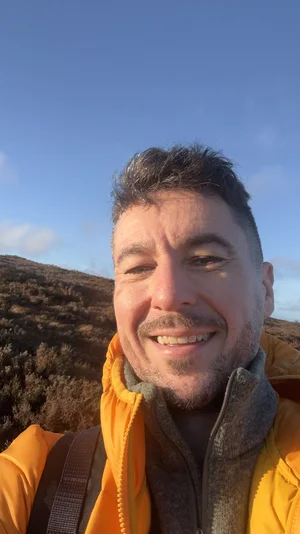
I almost didn't go. It was one of those November afternoons where the light starts failing by three o'clock and the sensible thing would be to stay home. But the forecast promised clear skies, and there's something about winter sun that pulls me out the door even when the cold says otherwise.
Trail Facts & Stats
⚠️ Status: Coastal Path Closed (This guide follows the safe Bray Head alternative route).
Distance: 9 km (One way).
Time: 2.5 – 3 hours.
Difficulty: Moderate (Includes a steep climb up Bray Head).
Start Point: Bray DART Station.
End Point: Greystones DART Station / Harbour.
Gear: Hiking boots recommended (can be muddy).
Is the Bray Cliff Walk Closed?
Yes, the traditional lower cliff walk is currently closed due to rockfall and landslides. However, the closure turned out to be a gift, in a way. It forces you onto the alternate route, the one that climbs inland over Bray Head itself. I'm not sure I'd have found it otherwise, but it offers better views than the lower path ever did.
Getting There: Starting from Bray DART Station
I took the DART commuter train from Dublin City (approx 45 mins) and walked along the promenade as the afternoon light stretched long across Bray beach. A few dog walkers, a couple of runners, but mostly quiet. The town has a faded Victorian charm that suits winter - the amusement arcades closed up, the hotels looking out at an empty sea.
The path up Bray Head starts gently enough, curving away from the coast and into the trees. Within ten minutes the noise of the town had faded and I was climbing through gorse and heather, the ground firm from recent frost. The cold had sharpened everything - the air tasted clean, and my breath hung visible in front of me.
The Climb: Hiking up Bray Head Cross
The route up Bray Head is steeper than it looks from below. I won't pretend otherwise. There's a section where the path narrows and rises sharply, and if you're not used to hills, you'll feel it in your legs. I stopped a few times, not because I needed to catch my breath - though I did - but because the views kept demanding attention.
To the east, the Irish Sea stretched flat and silver in the low light. To the west, the Wicklow Mountains rose in layers, each ridge a slightly different shade of purple and grey. And below, the curve of the coast ran south toward Greystones, the railway line tracing the cliff edge like a pencil mark.
The cross at the summit of Bray Head is a simple concrete structure, but it marks the spot where everything opens up. Standing there in the last hour of daylight, I could see north to Dublin Bay, south toward Wicklow Head, and inland to the Sugar Loaf and beyond. The wind was cool, but I didn't want to leave.
The Ridge Trail to Greystones
From the cross, the alternate route continues south along the ridge above the old cliff walk. This is the section I hadn't expected - a grassy path that follows the contour of the hill, with the sea on one side and rolling farmland on the other. Sheep scattered as I approached, their winter coats thick against the cold.
The light was doing extraordinary things. The sun sat low on the horizon, turning the sea to hammered gold and throwing long shadows across the hillside. Every few minutes the colour shifted - amber to rose to deep orange - and I kept stopping to watch it change. This is what winter walking gives you. The days are short, but the light is incomparable.
I passed the trig point at Ballynamuddagh and began the descent toward Greystones. The path here is easy, dropping through farmland on trails that are well paved and accessible.
Descent into Greystones Village
By the time I reached the edge of Greystones, the sun had dropped below the horizon and the sky had turned that deep winter blue that comes just before dark. The lights of the town were starting to flicker on, and I could smell woodsmoke from somewhere nearby.
The route had taken me about two and a half hours, maybe a bit more with all the stopping.
Why choose the Alternative Route?
The main cliff walk gets all the attention, and I understand why - the coastal path is dramatic, hugging the edge with the sea crashing below. But the inland route offers something different. You earn the views. You climb for them, and when they arrive, they feel like a reward rather than a given.
And the winter light. I keep coming back to that. Summer has its charms, but there's something about low sun on a cold afternoon that makes familiar landscapes feel new. The colours are richer, the shadows longer, the air clearer. If you can handle the chill, winter walking in Ireland is deeply underrated.
Practical Tips for the Hike
Transport: The DART runs between both towns, so you can easily get back to Bray or Dublin City without retracing your steps.
Food & Drink: Greystones has excellent options for a post-hike meal. I recommend looking near the Marina or the main street for local cafes.
Timing: If you're attempting it in winter, keep a close eye on sunset times. The light goes quickly once the sun drops.
A Different Kind of Walk
I've walked variations of this route several times now, in different seasons and different weather. But this winter afternoon stands out. There was something about the quality of the light, the bite of the cold, the emptiness of the trail that made it feel like the landscape was offering something it doesn't always give.
That's what I'm always chasing with this work - those moments where a familiar place becomes unfamiliar, where the light or the weather or your own state of mind transforms a walk into something more than exercise. The Bray Head inland route, on the right afternoon, delivers that.
If the cliff walk ever reopens, I'll be glad to have both options. But I'm grateful the closure pushed me up and over the hill instead of around it. Sometimes the detour turns out to be the destination.
I filmed this walk for the channel—you can find it on YouTube. If you're planning to walk the route yourself and have questions, feel free to reach out via the Contact page.